


Understanding Verifiable Credentials
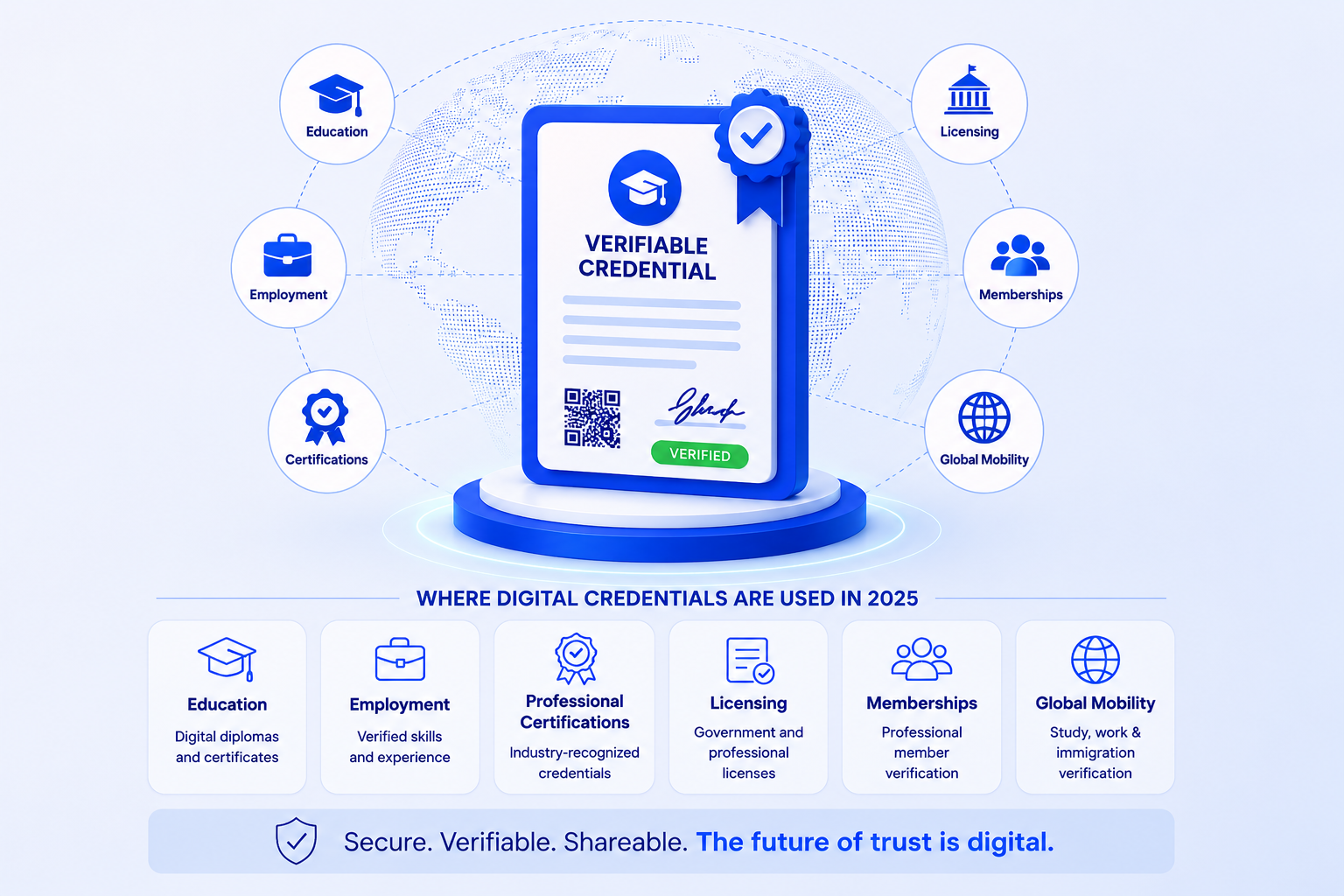
Digital credentials have transformed the way we store and display abilities, offering remote organization and, more importantly, rapid credential verification. While digital credentials themselves are not new, today’s iterations come with robust encryption features that render them impenetrable, secure, and verifiable. These digital counterparts carry all the essential information just like their physical counterparts but with the added advantage of tamper-evident and credible digital signatures.
The Components of Verifiable Credentials
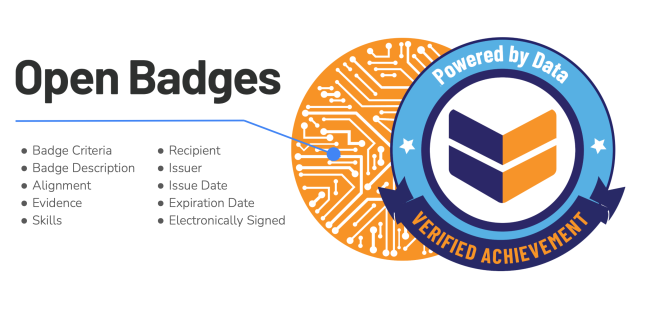
Verifiable Credentials consist of three fundamental components, each contributing to their integrity and security. How these components are formally structured and protected is defined by the standards that govern verifiable credentials, including W3C, Open Badges 3.0, and Europass:
-
Metadata
Metadata is information about data or information. It helps users identify data within repositories and comprehend the underlying information. This valuable aspect of verifiable credentials ensures efficient data management, organization, and utilization. -
Claims
Claims management is crucial for maintaining up-to-date records and safeguarding critical documents. An integrated claims management system (CMS) is a valuable tool that businesses can employ to streamline their claims operations, reducing the risk of document loss. -
Data Proofs
Advanced technological capabilities have led to the increased popularity of cloud services. Data Proof protocols (PDP) play a pivotal role in ensuring the security, accuracy, and integrity of datasets stored on cloud servers.
The Verifiable Credentials Model
Understanding the Verifiable Credentials Model
The model of verifiable credentials operates through three key roles:
-
The Issuer
W3C Verifiable credentials offer a cryptographically secure way to establish the identity of an entity through verifiable attributes. Issuers are responsible for generating each verifiable credential, maintaining records about the individuals to whom the credentials are issued. -
The Holder
The individuals or entities possessing verifiable credentials are referred to as holders. They have complete control over their credentials, safely displaying, sharing, or storing them without fear of tampering or unauthorized access. -
The Validator
The role of a validator is to verify the accuracy of credentials on behalf of third parties, such as recruiters assessing qualifications. Validators play a crucial role in the trustworthiness of verifiable credentials.
Why Choose Verified Certificates?
There are compelling reasons to opt for verified certificates:
-
Accurate Assessments
Digital certification programs incorporate graded tests and advanced tracking technologies, ensuring learners receive precise assessments. Analytical grading methods provide unbiased results based solely on performance metrics. -
Secure and Verified
Verified certificates leverage blockchain technology for issuance, enhancing security through bank-level encryption. This encryption ensures document integrity and protects against unauthorized access, with records securely stored in digital databases. -
Shareable Credentials
Learners can share verified certificates across digital platforms, including social networks like Facebook, Twitter, and LinkedIn. These certificates can be embedded in portfolios, CVs, and resumes, enhancing career prospects and professional development.
Conclusion
Verifiable credentials have ushered in a new era of trust and transparency in credentialing. Understanding their components and the benefits they offer, such as accurate assessments, security through blockchain, and shareability, can empower organizations to make informed choices about adopting this innovative approach to credentialing. In a rapidly evolving digital landscape, verifiable credentials are the future of credential recognition.
Frequently Asked Questions
What's the difference between metadata and the actual claim?
Think of the claim as the ‘what’—like ‘I passed this course.’ The metadata is the ‘context’—who said you passed, when they said it, and how long it’s valid. Without metadata, a digital credential is just a picture.
Why do we need a 'Validator' if the data is on a blockchain?
The blockchain is just the record-keeper. You still need a validator (like a hiring manager or a system) to actually look at that record and say, ‘Yes, this matches what the applicant is telling me.’ It’s the final step in the trust loop.
Can I share these credentials on my LinkedIn profile?
Definitely. Most modern platforms have a one-click share button. It’s much more professional than just typing it in your bio because anyone who clicks it can see the actual proof behind your claim.
Is this technology only for tech companies?
I’ve seen it used in healthcare, manufacturing, and even traditional nonprofits. Any place where you need to trust someone’s skills without spending days on background checks is a perfect fit for verifiable credentials.