 Author :

A digital badge from Coursera, a university transcript from MIT, a course certificate from an eLearning platform — these are all examples of verifiable credentials. Each one is a secure digital document that proves a person’s achievement, skill, or identity and can be instantly checked for authenticity.
This article walks through real-world examples, the components that make them work, and the industries adopting them.
TL;DR
-
Verifiable credentials are secure digital documents that prove achievements, skills, or identity, and can be verified instantly without contacting the issuer.
-
Each credential contains structured components: issuer details, recipient information, metadata, verification tools, and a cryptographic signature.
-
Industries like education, corporate training, eLearning, and professional associations are adopting them to replace slow, manual document verification.
-
The credential format varies — transcripts, certificates, and digital badges — but the underlying verification mechanism is the same across all of them.
Core Components of a Verifiable Credential
Let us now uncover the core components of a verifiable credential using a real example. In the given image, you can observe the overall interface and the various components of a verifiable credential, which are described individually below :
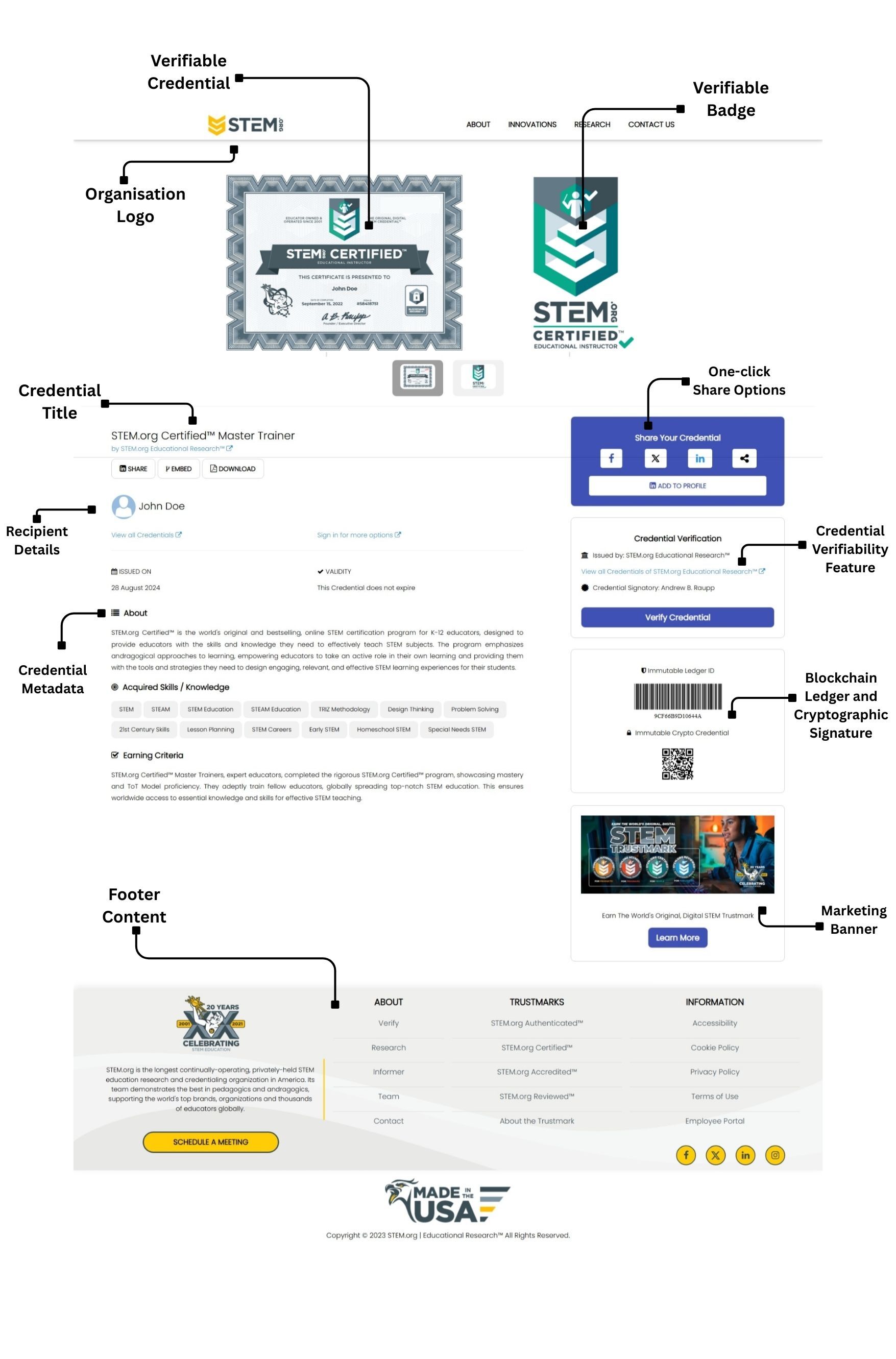
Organizational Logo
The logo identifies the issuing institution. It’s the first thing a viewer sees and signals who stands behind the credential.
Verifiable Certificate or Badge
This is the credential itself, displayed as a certificate, badge, or transcript depending on the organization’s requirements. It’s digitally issued and instantly verifiable online.
Credential Title
The official name of the achievement. For example, “STEM.org Certified Master Trainer” tells a verifier exactly what was earned without needing additional context.
Recipient Details
The information needed to identify who earned the credential. Only what’s necessary for identification is included, keeping the holder’s personal data minimal and private.
Credential Metadata
This is the structured background data that a verifier needs to fully understand the credential. It includes:
- Issue date and expiration date
- Credential description
- Issuer details
- Skills the recipient acquired
- Eligibility criteria explaining what the recipient did to earn it
Social Share Options
Recipients can post their credentials directly to LinkedIn, X (formerly Twitter), or Facebook in one click. This benefits the recipient’s professional visibility and the issuing organization’s reach at the same time.
Credential Verification
A button or link that lets anyone confirm the credential’s validity instantly, without emails or phone calls. The check runs automatically against the issuer’s records.
Blockchain Ledger and Cryptographic Signature
The technical foundation of the credential. The blockchain ensures the record can’t be quietly altered after issuance. The cryptographic signature confirms it came from the claimed issuer. If anything changes after signing, verification fails immediately.
Marketing Banner
A graphic element that reinforces the issuing organization’s brand identity. It can be used in communications and helps recipients associate themselves with the institution.
Footer Content
Located at the bottom of the credential page, this section includes issuer information, trust marks, legal links, and contact details for anyone who wants to follow up.
Use Cases Across Industries
Verifiable credentials come in different formats depending on the use case — transcripts, course completion certificates, and digital badges are the most common. Each industry tends to favor one format over another, but the verification mechanism works the same way across all of them.
Education (Universities and Colleges)
Colleges and universities use verifiable transcripts and certificates to replace paper versions. Traditional paper systems are slow and vulnerable to fraud. A verifiable transcript removes the delays involved in printing, mailing, and manual verification — a verifier can confirm authenticity in seconds instead of waiting days.
Corporate Learning and Development
Organizations need to track training completion before considering employees for advancement. Verifiable digital badges and certificates give HR teams reliable proof of participation and completion without manual record-keeping.
eLearning Platforms
A verifiable certificate adds credibility to a course and motivates learners to complete it. Whether the course is introductory Excel or advanced data science, a credential that can be independently verified carries more weight than a PDF.
Professional Associations
Associations issue credentials for membership and certifications, license renewals, and continuing education. Digital badges work well here because they’re compact, carry expiry dates, and get automatically revoked when a membership lapses. Moving to verifiable credentials simplifies administration and gives members proof they can store and share from anywhere.
Why Organizations Choose CertifyMe
For organizations looking to issue verifiable credentials without building infrastructure from scratch, CertifyMe provides a ready digital credentialing platform. It supports certificates, badges, and transcripts, and handles the cryptographic signing and verification process automatically. There’s a free plan available to test how issuance works before committing to a full rollout.