 Author :

Yes, verified credentials are legit.
The more useful question is why — and the answer comes down to three things: how they’re secured, how they’re verified, and what standards they follow.
This article covers all three so you can judge for yourself.
TL;DR
-
Yes, verified credentials are legit. They’re built on technology that makes tampering immediately detectable.
-
When a credential is issued, it’s recorded on an immutable ledger and signed with a cryptographic signature. Any change to the credential breaks both, and verification fails instantly.
-
Global standards like W3C Verifiable Credentials and Open Badges 3.0 ensure these credentials work consistently across platforms and countries.
-
For regulated sectors, compliance with ISO certifications and laws like FERPA and GDPR adds a further layer of accountability.
They Can’t Be Altered Without Getting Caught
When a verified credential is issued, it gets linked to an immutable ledger. Immutable means it can’t be changed. The ledger records the credential exactly as it was at the moment of issuance.
Every time someone verifies the credential, the system checks the current version against that original record. If anything has changed, even a single character, the two won’t match and verification fails instantly.
This is what makes verified credentials hard to fake. There’s no way to quietly edit a name, a grade, or an expiry date and have it go unnoticed. For a deeper look at how blockchain secures credentials, the technology behind immutable ledgers is covered in detail separately.
The Cryptographic Signature Confirms the Issuer
Security stops forgery. But a separate question is: how do you know who actually issued the credential?
A cryptographic signature answers that. When an institution issues a credential, it signs it with a private key that only that institution holds. Anyone verifying the credential uses the corresponding public key to confirm the signature came from that source.
In practice, this is straightforward. On CertifyMe’s platform, a verifier can enter the credential’s unique ID on the verification page. If the signature checks out, the credential is confirmed as genuine and untampered.
No phone calls. No emails to a registrar. The math does the confirming.
Global Standards Make Them Consistent and Trustworthy
A credential being secure is one thing. A credential being recognized and trusted across different systems and countries is another. That’s what standards are for.
Two frameworks matter most here.
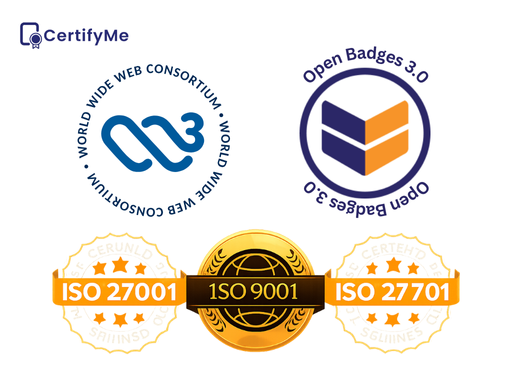
The W3C Verifiable Credentials Data Model, maintained by the World Wide Web Consortium, sets the technical requirements every compliant credential must meet: cryptographic signing, machine-verifiable structure, and privacy protection for the holder. If a credential follows W3C, anyone with a compatible system can verify it anywhere.
Open Badges 3.0, built on top of W3C, is designed specifically for educational and professional achievements. It embeds detailed metadata directly into the credential, including what was earned, how it was assessed, and who issued it.
Compliance Adds Another Layer in Regulated Sectors
For organizations in education, healthcare, or any field with legal data requirements, compliance matters beyond just the credentialing standards.
Platforms like CertifyMe hold ISO 9001 (quality management), ISO 27001 (information security), and ISO 27701 (privacy management) certifications. They also comply with FERPA for student data in the US, GDPR for European data protection, and COPPA for privacy protections involving minors.
These aren’t credentials-specific standards. They’re the same certifications any serious software platform handling sensitive personal data is expected to meet. Their presence confirms that the platform managing credential data is held to external, auditable requirements.
Why This Matters If You’re Evaluating Adoption
The legitimacy of a verified credential depends on the platform that issues it following these standards correctly. Not every platform does.
When evaluating a credentialing platform, the questions worth asking are: Is it W3C-compliant? Does it support Open Badges 3.0? What ISO certifications does it hold? How does it handle revocation if a credential needs to be invalidated?
Understanding credential fraud risks is also worth doing before committing to a platform, since the protections described in this article only hold when the issuing platform implements them correctly.
CertifyMe meets all of these. There’s a free plan available if you want to test how issuance and verification work before committing to a full rollout.