




Event and meeting teams can issue digital credentials for attendance, speaking, volunteering or assessed completion. What matters is the award’s meaning: attending a session is not the same as demonstrating a skill.
This guide helps organisers choose award criteria, collect necessary recipient information and plan delivery, verification and corrections. Define those responsibilities before choosing a template or enabling automation.
Use the examples below to decide which achievements your event should recognise and what evidence should accompany each award.
What Are Digital Credentials, Really?
Digital credentials are electronic records of an achievement. Verification features depend on how the issuer creates and maintains the credential.
Think of it this way:
-
Your paper certificate is like a photo on your fridge—nice to look at, but it just kind of… stays there.
-
A digital achievement record can describe an issuer’s award and provide a supported verification route. It is not a verified social-media account or independent identity proof.
Here’s what they usually include:
-
Your name
-
What you did (like attending, volunteering, or speaking)
-
Who issued it (say, your university, a conference, or an event host)
-
A unique link so anyone can verify it’s real
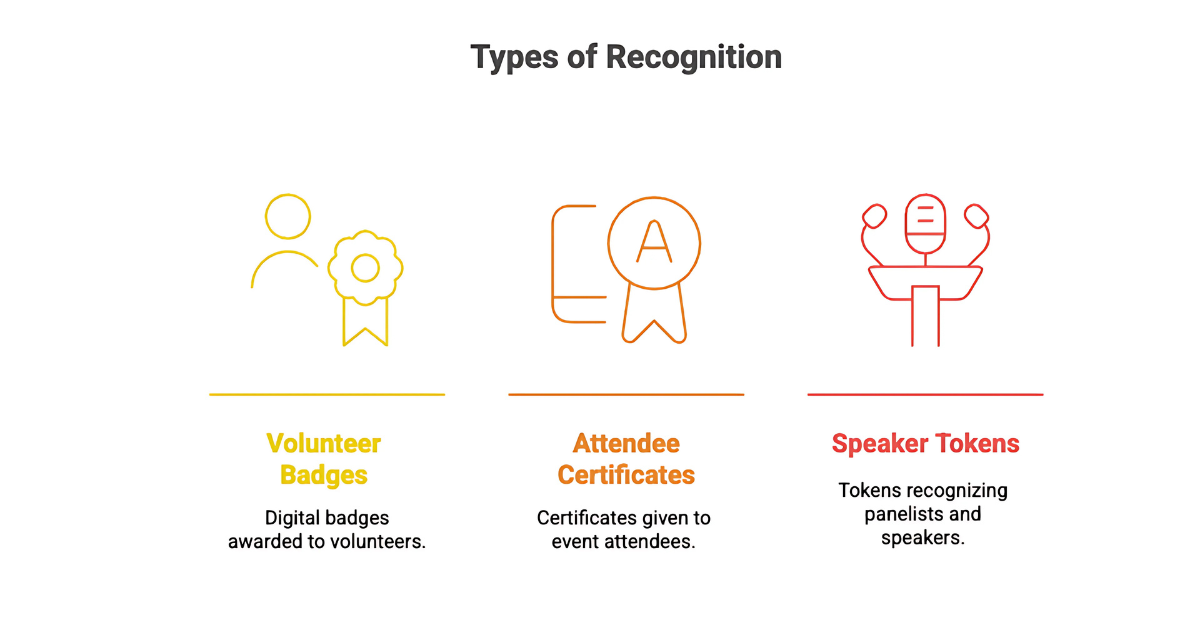
They come in many forms:
-
Digital badges for volunteers
-
Certificates for attendees
-
Recognition tokens for panelists and speakers
It’s not just a trend. It’s a smarter, more efficient way to give credit where it’s due.
Want a visual explainer? Watch this quick video on digital credentials and open badges to see how they work and why they’re trusted.
Why Should Event and Meeting Professionals Care?
You might be thinking,
When are digital credentials useful for an event?
Let’s talk through it.
Imagine organizing a university leadership summit, an alumni reunion, or a speaker panel. There’s effort, planning, follow-ups, and chaos management.
Now add one more layer: issuing attendance certificates, volunteer records, or speaker acknowledgments. Paper-based systems just don’t cut it anymore.
Here’s why digital credentials are a better fit:
-
Easy to Share (and Hard to Fake)
Everyone loves a little spotlight. Whether it’s a student sharing their first conference badge or a keynote speaker updating their portfolio—digital credentials make sharing simple.
-
Attendees can drop credentials onto LinkedIn in seconds.
-
Speakers can embed them on personal websites.
-
Recruiters can click a link to verify it’s legit.
A supported record check may reduce some manual enquiries; official clarification can still be necessary.
Tamper evidence is not fraud elimination. False issuer claims, compromised keys and recipient impersonation remain risks.
A credential URL or QR link can lead to the hosted record. The receiver still checks issuer authority, criteria, proof, dates/status and recipient association.
-
-
Saves Time (and Your Sanity)
Digital issuance reduces printing and envelope handling. Recipient names, award criteria and corrections still require review.
With digital credentials, the process goes something like this:
-
Upload your attendee or volunteer list
-
Choose a credential template
-
Click issue
That’s it.
No printers. No mailing costs. No manual data entry.
More time for what matters—planning a better event.
-
-
Looks Good on You, Too
Your event isn’t just an event. It’s a brand.
Whether you’re representing a university department, a student-led club, or an industry group—how your event lives on matters.
Digital credentials carry your logo, your color palette, and your event name wherever they go. They’re mini billboards, reminding people:
-
Give participants a shareable record of what they achieved at your event.
-
Your audience valued the experience enough to share it.
-
And it wasn’t just another checkbox—it was meaningful.
For event organizers and universities, it’s also worth exploring how digital credentials can enhance your marketing strategy by reinforcing your brand through every share.
-
-
Helps Participants Build Real-World Portfolios
Especially in university settings, students are constantly hunting for experiences that set them apart. But saying “I volunteered at a conference” is different from showing a verified badge that proves it.
Digital credentials are proof in pixels—evidence that backs up soft skills and experience.
-
Teamwork?
-
Public speaking?
-
Event planning?
-
Professional development?
An assessed award can describe a relevant capability, but a record does not automatically improve hiring equity. Read evidence-aware hiring guidance for the separate decision and access responsibilities.
University Use Cases
Let’s zoom in on campus life for a second. Universities have jumped on the digital credentials train—and for good reason.
Here’s what’s happening:
Student Clubs and Organizations
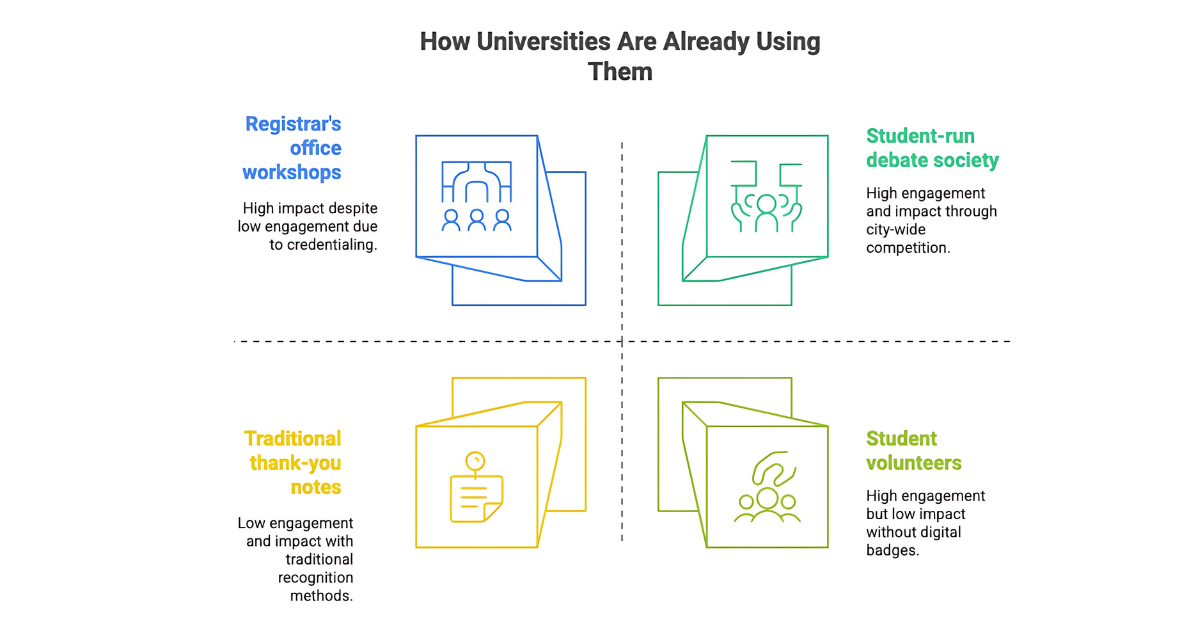
A student-run debate society organizes a city-wide competition. Each participant gets a shareable digital badge that:
-
Lists the role (debater, judge, volunteer)
-
Shows the event date and issuer
-
Links directly to a verification page
Instead of collecting dust, these credentials get posted, clicked, and remembered.
Registrar’s Office and Academic Events
Workshops, seminars, and development programs often go unnoticed—until they’re credentialed.
-
Academic skills workshops? Credentialed.
-
Diversity and inclusion training? Credentialed.
-
Career prep sessions? You guessed it—credentialed.
Now there’s a way to track participation and incentivize engagement.
Student Volunteers and Interns
From library assistants to event marshals—students put in time outside the classroom. Why not give them something more than just a thank-you note?
A digital badge can:
-
Help them prove experience
-
Support future internship or job applications
-
Reflect soft skills and dedication
It’s recognition that sticks.
What Do Digital Credentials Look Like?
If you’re picturing a boring PDF, think again.
Digital credentials are visual, dynamic, and personalized.
A typical credential includes:
-
Your full name
-
A description of the achievement or activity
-
The issuing organization (with its logo and signature)
-
Date of issuance
-
A scannable QR code or clickable link
They can also include metadata—basically hidden data that explains more:
-
Learning outcomes
-
Hours completed
-
Skill tags like “leadership,” “event management,” or “teamwork”
And here’s where it gets fun—
Recipients can post them:
-
On LinkedIn
-
In their email signatures
-
On digital portfolios
-
Even inside job applications
These aren’t static awards—they’re alive in the digital world.
Organizations and associations are also adopting them—see how associations use digital credentials for member recognition to boost engagement and loyalty.
What event verification does—and does not—show
A signed achievement record can be tamper-evident under its supported proof mechanism. A QR code or URL directs someone to a record; it is not the proof itself. The receiver should inspect issuer authority, the stated achievement, dates and applicable status. Neither blockchain nor a badge image independently proves attendance, competence or recipient identity.
The 1EdTech Open Badges 3.0 specification describes achievement records. Receiver compatibility and issuer-key/status continuity must still be tested; global interoperability is not automatic.
Define the award before the event
An attendance credential should say attendance; a volunteer-role record should describe the role and hours if validated; an assessed workshop credential should name its assessment criteria. For a campus conference, the organizer maintains the attendee evidence and an authorized institution approves the record. Set a correction deadline, a support contact and a consent policy before issuing.
Use institutional Open Badges guidance for award structure and connected learner records where co-curricular achievements need provenance. Count issued awards and corrections separately from page views; views are not proof of learning or event ROI.
Final Thoughts: It’s Not Just a Trend
Choose digital credentials when their verification and delivery features meet your programme’s needs.
Digital credentials aren’t trying to replace traditional certificates just for the sake of it. They’re responding to a real need—for easier validation, faster sharing, and more meaningful recognition.
As someone organizing, hosting, or even attending an event, you know that what happens during the event matters.
But so does what happens afterward.
A digital credential becomes a memory, a record, and a message all in one:
-
You were there.
-
You made an impact.
-
And now you have proof.
Whether you’re managing conferences, leading student clubs, or part of a registrar’s team—it’s worth exploring.
Not because it’s trendy. But because it’s useful, thoughtful, and lasting.
Why Event Pros Should Use Digital Credentials:
Benefits to consider when choosing a credential format:
-
They’re easier to issue (say goodbye to printing stress)
-
They’re simple to share (LinkedIn, email, anywhere)
-
They boost your event brand (your name travels with the credential)
-
They help participants grow (real proof of real effort)
-
Their reliability depends on award governance and the supported verification method—not merely being digital.

A Final Nudge: Try It Once
Still unsure? Try issuing digital credentials at your next event.
-
Start with a small workshop.
-
Offer badges to volunteers.
-
See how your audience responds.
Measure optional sharing and participant feedback in the pilot rather than predicting a particular response.
And you? You’ll have saved time, reduced paper clutter, and added a modern touch to your event planning.
Not bad for a few clicks.
How CertifyMe Helps Event Professionals Issue Verified Digital Credentials
If you’re convinced that digital credentials can transform how you recognize and engage participants, the next question is—where do you start? That’s where CertifyMe comes in.
CertifyMe is a leading digital credentialing platform built for modern organizations, universities, and event professionals. It allows you to issue secure, verifiable, and beautifully designed digital badges and certificates with just a few clicks. Whether you’re managing a student conference, a professional development workshop, or a large-scale industry event, CertifyMe makes credentialing simple, efficient, and impactful.
Issue Credentials in Minutes
With CertifyMe, you can upload participant data (from CSV files or spreadsheets), customize your badge or certificate design using built-in templates, and issue credentials in bulk. Electronic delivery avoids physical printing and envelopes. Delivery timing depends on approved data, processing and email receipt; test the actual workflow before promising a deadline. Attendees can receive credentials, with embedded verification links and shareable badges they can proudly post to LinkedIn, email signatures, or personal portfolios.
Security and verification responsibilities
CertifyMe’s public OB3 issuer listing supplies scoped conformance evidence. Test the actual proof, recipient matching, correction and status behavior for your event. A platform cannot independently establish that someone participated merely because an organizer uploaded their name.
Custom Branding That Promotes Your Event
Your event is part of your brand, and CertifyMe helps it live on. You can fully customize the look and feel of your credentials—adding your logo, event name, brand colors, and more. Every time a recipient shares their credential online, your event gets organic visibility, acting as a mini digital billboard for your organization.
Track Credential Engagement
Want to know how your issued credentials are performing? CertifyMe gives you access to analytics dashboards that track opens, shares, and verifications. This means you not only see how your audience is interacting with their credentials, but also gain insights into the value and reach of your event.
Ideal for All Event Types
Whether you’re credentialing volunteers, workshop attendees, speakers, or student organizers, CertifyMe has flexible options that suit your event’s structure. It’s especially useful in academic and professional settings where participants expect recognition that’s portable, verifiable, and credible.
Want Help Getting Started?
Well, digital credentials aren’t just a “nice touch” anymore—they’re becoming part of how we build trust in professional and academic spaces. Whether you’re planning events, managing student records, or attending workshops, these credentials help make your involvement visible. And not just to yourself, but to others who might one day want to know what you’ve done.
Digital credentials can help participants present achievements and help event teams manage award records.
From events to enterprise training programs, the need for verified proof of achievement is growing. Learn more about business use cases for digital credentials across industries.
If you’re curious about using digital credentials in your events or academic programs, CertifyMe makes it simple to get started. Their platform is easy to use, fully verifiable, and designed with both students and professionals in mind. It’s a solid way to keep things organized while giving people something meaningful to walk away with.
Want to see it in action? Book a demo with CertifyMe and explore how it could fit into your next event or program.
Frequently Asked Questions
Does an event badge prove a skill?
Only if the stated criteria and assessment support that claim. Attendance, a volunteer role and demonstrated competence are different achievements.
Does a QR code make an award impossible to fake?
No. It provides access to a record. Proof, issuer authority, recipient matching, dates and status must be checked separately.