01 · For the Registrar
Less manual coordination, centralized workflow, request visibility and verification support.
Transcript Management
Connect your SIS, automate transcript workflows, and give learners secure record access.
EduTranscript by CertifyMe · Institutional academic-record infrastructure
The institutional challenge
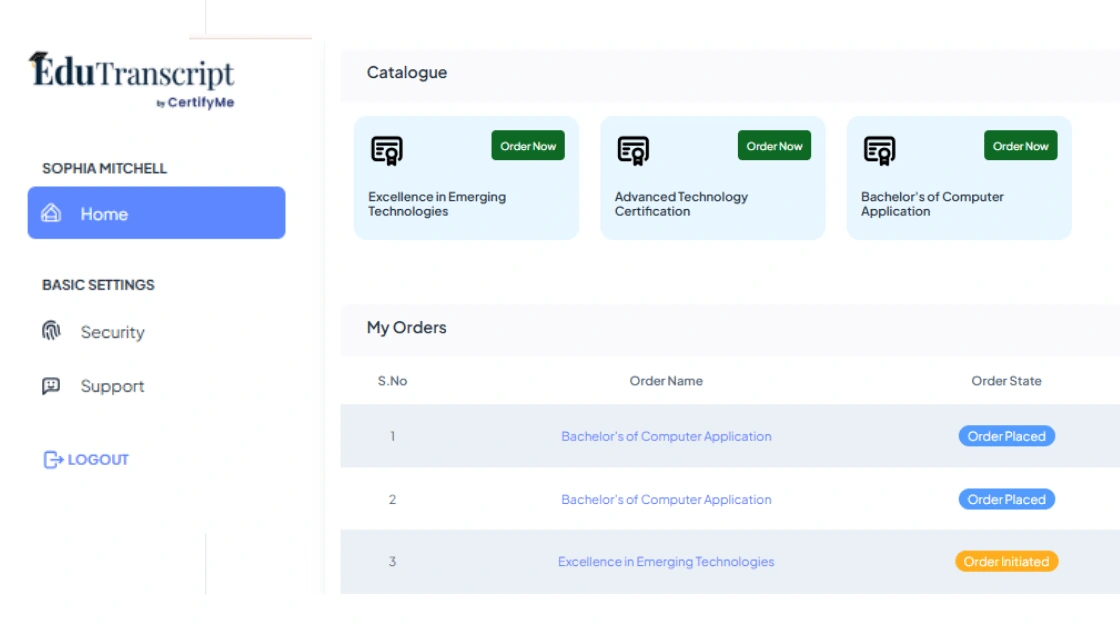
Requests often touch email, document preparation, printing or scanning, postage, follow-ups and repeated verification. Each hand-off adds work for registrar and student-service teams—and leaves learners asking about status.
Students and alumni need records at consequential moments: graduate admissions, employment, licensing, immigration, international study and credential evaluation.
A transcript request is not an isolated administrative transaction. It is part of the learner's academic and professional journey.
A connected process
CertifyMe helps universities automate transcript workflows, give students and alumni secure access to their academic records, integrate with existing student information systems, and issue transcripts that can be independently verified.
The institution sets eligibility, review and authentication requirements. A product explainer is available from CertifyMe's EduTranscript channel.
Registrar operations
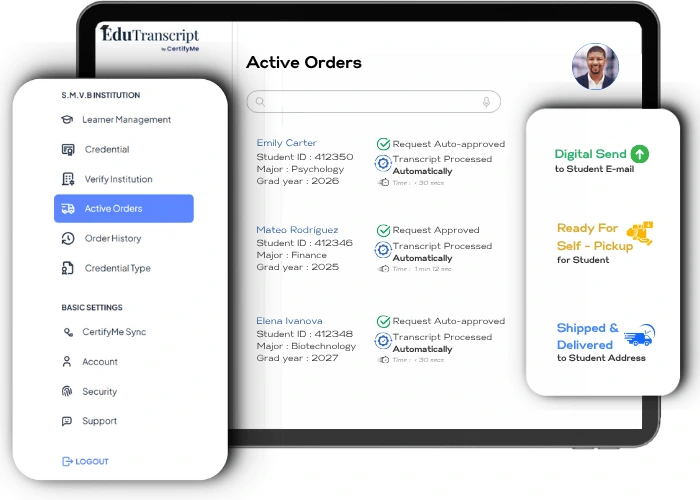
A centralized institutional workflow can bring request review, approval, processing, dispatch and status visibility into one operating path—reducing manual coordination across teams.
Keep incoming requests, student information and request details together, with visibility into the processing state and delivery state.
Student and alumni portal
A student-facing portal supports requesting, status updates, notifications, access and sharing. The university determines access eligibility and the details of its process.
Students can view and download issued records, then share a secure link or verification code with their chosen recipients.

Access over time
Graduates may need an official academic record long after leaving campus. Secure digital retrieval can reduce the need to begin every request from scratch, subject to institutional access and retention policies.
One institutional record, available when needed—within the access, privacy and retention rules the university sets.
Trust starts with the issuer
Paper and digital records can be misrepresented or changed. Verifiable issuance helps recipients assess provenance and integrity without treating any single control as proof of everything.
Identity association, recipient-controlled access and cryptographic signing address different risks. Together, the appropriate controls help recipients establish provenance and detect tampering.
Premium capability · recipient identity
Premium ID-based tagging associates a transcript with a supported primary identifier. Institutions can use supported identity references, such as a passport reference, to strengthen the connection between the record and its intended recipient.
Identity association helps connect a person to a record; it does not independently prove every aspect of transcript authenticity. Institutions choose the identifiers and process appropriate to their policy.
Identity association
Connect the academic record with its intended recipient.
Recipient-controlled access
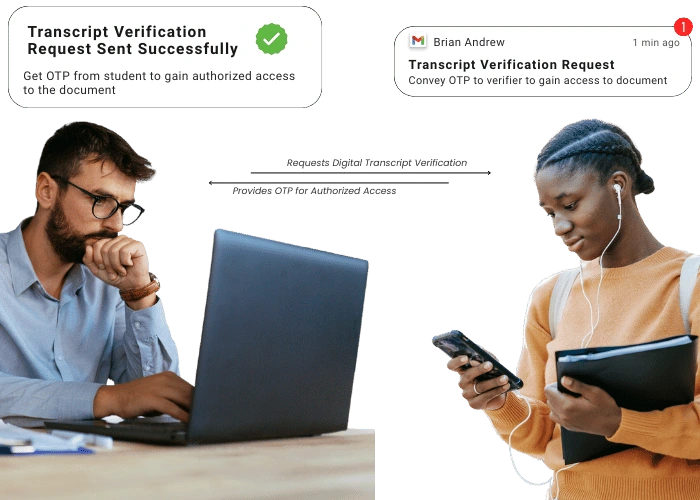
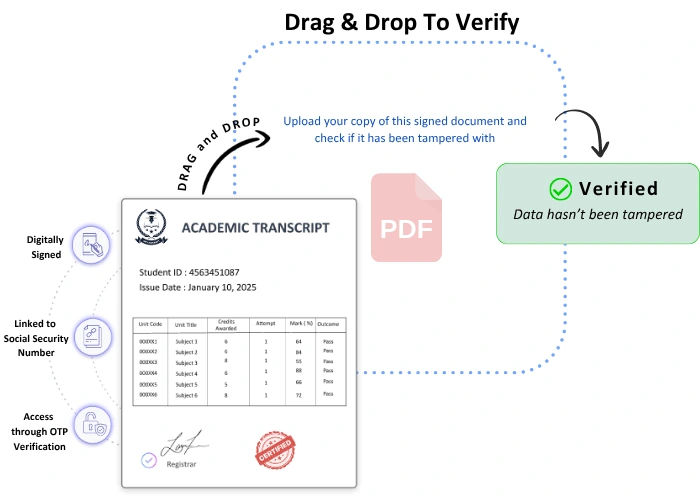
An OTP step can ask a student or alumnus to authorize access before a verifier receives a transcript. It supports recipient authentication and consent; it is not a cryptographic check of the document itself.
Document integrity
A cryptographic signature provides integrity and issuer-authenticity evidence for the signed document. It does not, by itself, establish every aspect of recipient identity.
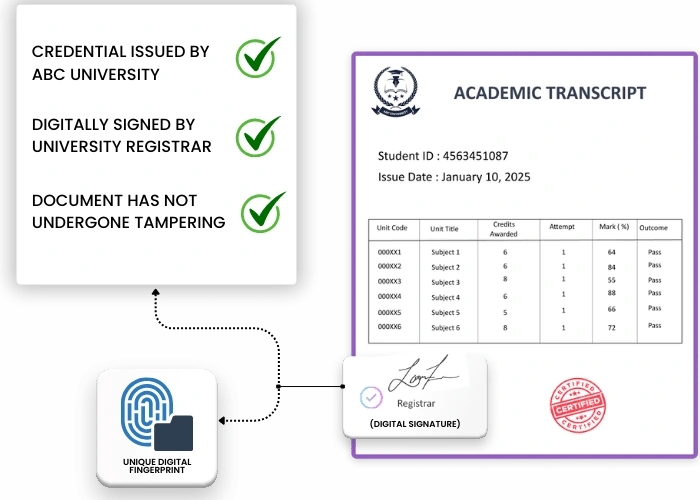
A mismatch indicates an integrity failure or alteration; it does not automatically establish fraud. Issuer and recipient checks remain distinct.
For employers and institutions
A verification experience gives third parties a direct way to check the information presented and its institutional provenance.
Review issuer authority, the named recipient and signed-document integrity as separate checks. Verification uses issuer keys and applicable status resources.
Choose the appropriate control
Institutions configure a verification model to fit their requirements. These methods are complementary options—not mandatory steps for every transcript.
| Method | Primary purpose |
|---|---|
| Credential ID / Verification Code | Find the institutional record |
| QR / Secure link | Access the verification experience |
| ID-based tagging | Associate the record with its intended recipient |
| OTP | Recipient authentication or controlled access |
| Cryptographic signature | Document integrity and issuer-authenticity evidence |
| Verification portal | Third-party validation |
| Signed Open Badge / Verifiable Credential | Structured credential verification, where applicable |
Read more about digital credential verification and the CertifyMe REST API.
Keep the source of truth
The SIS remains the institutional source of truth for student, course, grade, credit and academic-history data. EduTranscript can connect to university SIS systems through REST API integration, with scope defined for the institution.
Keep academic data in the system your university already trusts. Our team works with you to define the integration scope, record mapping and institutional workflow.
Institution-scoped connection
Where academic data is available in the institution's SIS, a REST API connection can support a workflow without relying on manual re-entry at every hand-off.

Institution-to-institution exchange
A verified digital transcript can help support admissions, transfer, graduate education, employment and credential evaluation. Its provenance remains connected to the issuing institution; acceptance is determined by the receiving organization.
A lasting institutional relationship
Alumni may need transcripts for a new role, further study or professional evaluation years after graduation. Transcript infrastructure can continue to support secure access, request tracking, retrieval, verification and sharing.
Institutional protection
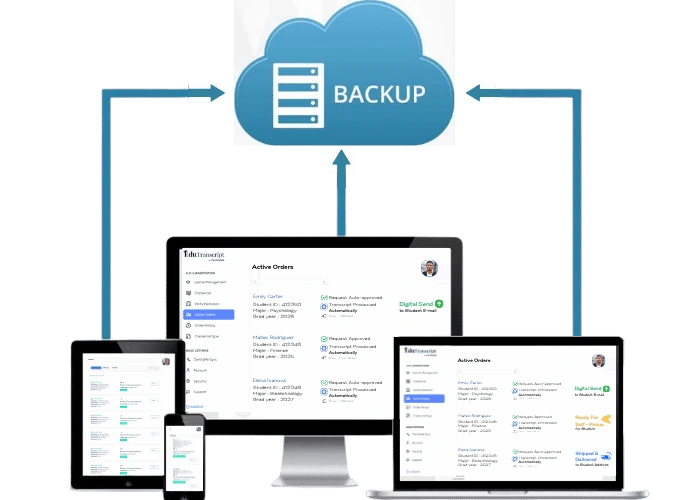
Protect sensitive learner information with encryption, role-based access and audit logging. Backup and recovery support continuity, while corrections and reissuance remain part of institutional record stewardship.
CertifyMe is designed to support institutional privacy and compliance requirements, including the considerations universities address under GDPR, FERPA and COPPA. Each institution must assess applicable law, policy, permissions and consent in its own context.
Review security and privacy practices with your IT and academic-governance teams.
Standards-based credential infrastructure
Connect the academic record with a standards-based credential strategy that supports structured data, portability and verification.
Open Badges 3.0 and W3C Verifiable Credentials support structured, machine-readable achievements and independent verification in supported credential formats. Choose the representation appropriate to your institution and receiving systems.
Explore digital credential infrastructure or see Skill Passport.
From transcript to connected achievement
The transcript remains the authoritative academic record. CertifyMe can connect it with other verified achievements and skills to create a broader learner record.
Courses · grades · credits · academic history
Certificates · badges · achievements
Skills · competencies
Projects · internships · activities
Bring these distinct sources of achievement together in a Comprehensive Learner Record, while preserving the transcript's academic authority.
Institution-configured mapping
As a wider CertifyMe platform connection, institutions can map learning outcomes to skills and taxonomies such as ESCO, O*NET or their own skill frameworks.
The mapping is configured by the institution. CertifyMe does not automatically infer skills from arbitrary courses or grades.
The wider platform
When institutions choose to connect these layers, workforce intelligence can add context around occupations, jobs, employers, locations and skill demand.
CertifyMe's Job Engine brings occupations, jobs, employers, locations and skill demand into that institutional view—helping university teams connect academic achievement, verified skills and workforce context.
Where transcript management fits
The first three layers form the core transcript infrastructure. Later layers represent configured connections across the wider CertifyMe platform.
Transcript and credential access
Open standards, where applicable
Identity association, signatures and verification
Academic achievements mapped to skills
Transcript, credentials and experiences
Skills connected to workforce context
A modern operating model
Institutional value
Designed for the offices that own academic records, technology, learner experience and institutional trust.
Less manual coordination, centralized workflow, request visibility and verification support.
SIS integration, REST API connection, standards where applicable and a security-minded architecture.
Self-service requests, status tracking, secure access and sharing when records are needed.
Direct verification options and clearer issuer provenance to support record review.
Less administrative friction, an improved learner experience, academic-record integrity and a foundation for modern learner records.
EduTranscript by CertifyMe
CertifyMe brings transcript requests, processing, delivery and verification into a modern digital workflow—while creating a foundation for secure, interoperable learner records.