Digital Credential Infrastructure for Institutions
Connect institution-approved awards with credential issuance, verification and learner records.
Enterprise-grade Digital Credential Management Platform
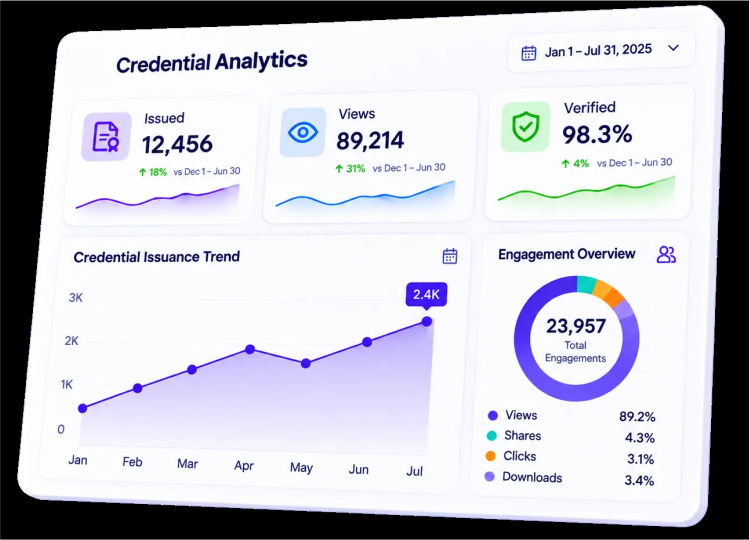
Credential Analytics & Engagement Insights
Measure the impact of your credential programs with real-time analytics on engagement, social sharing, profile visibility, and verification activity.
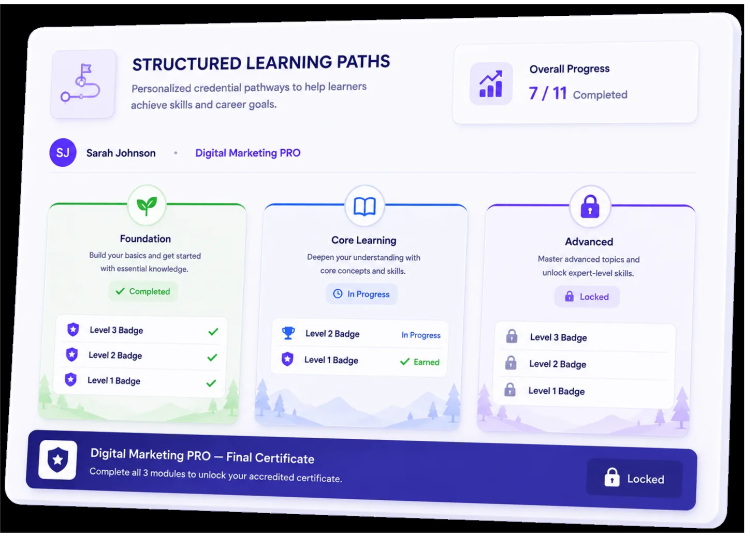
Structured Learning Paths
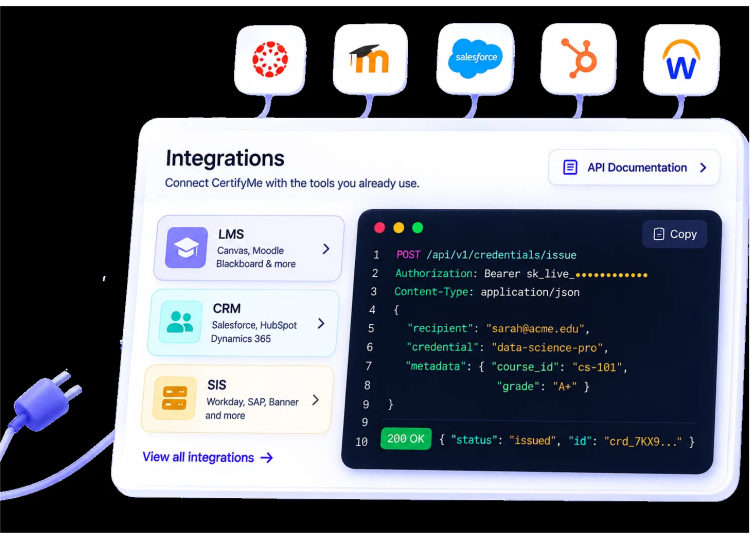
API & Enterprise Integrations
Fully Branded Credential Experiences
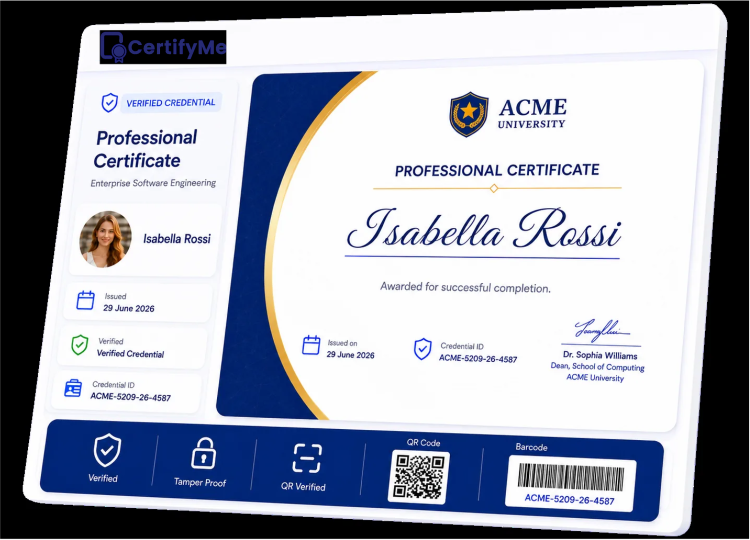
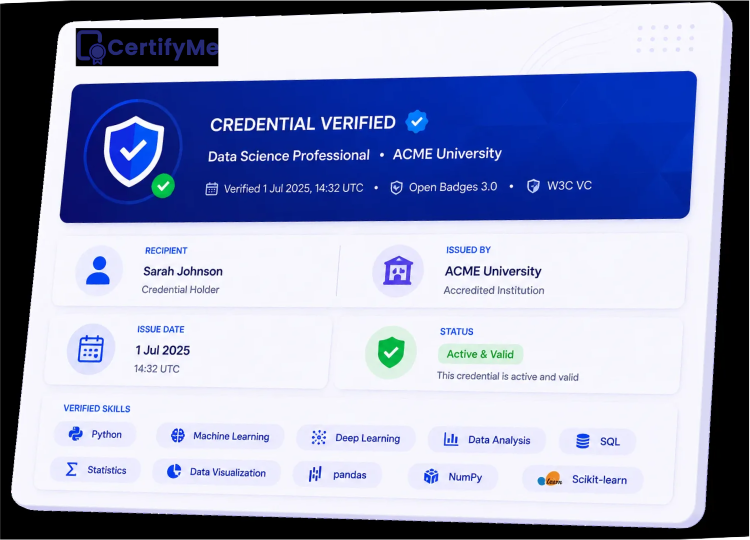
Credential Verification & Trust
Built for Institutions
CertifyMe serves the full spectrum of organizations that issue credentials and need to prove the value of their programs at scale.
Higher Education
Degrees, courses, achievements, transcripts and student credentials for universities and colleges.
Explore Higher EducationEnterprise
Employee learning, certifications, compliance and workforce development for L&D teams.
Explore EnterpriseCertification Bodies
Professional certifications, verification, renewals and credential lifecycle management for associations.
Explore Certification BodiesTraining Providers
Courses, assessments, badges and learner recognition for e-learning platforms and training organizations.
Explore Training Providers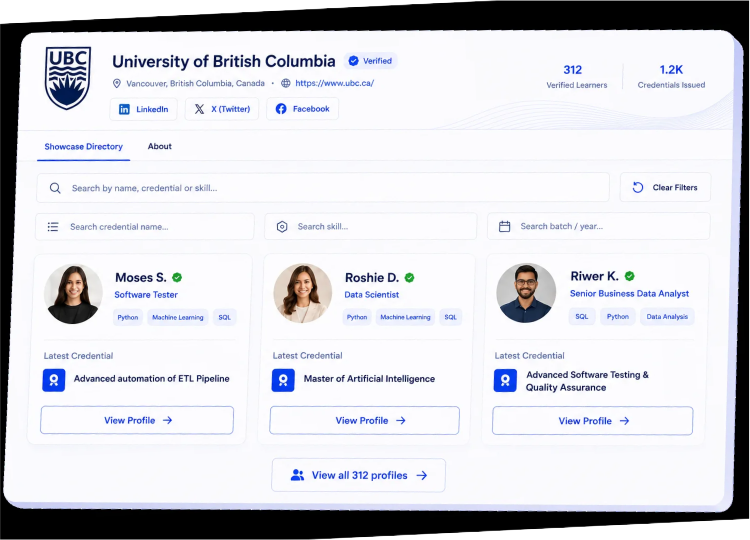
Help Learners Demonstrate the Value of Your Credentials
-
Amplify Your Institution's Reach Help learners share credentials and skills they have earned — extending your institution's brand into the workforce.
-
Build Employer Confidence Rich talent profiles showcase verified skills, projects, and achievements.
-
Measure Programme Impact Track employer engagement and placement outcomes with actionable insights.
Demonstrate the Workforce Relevance of Your Learning Programs
-
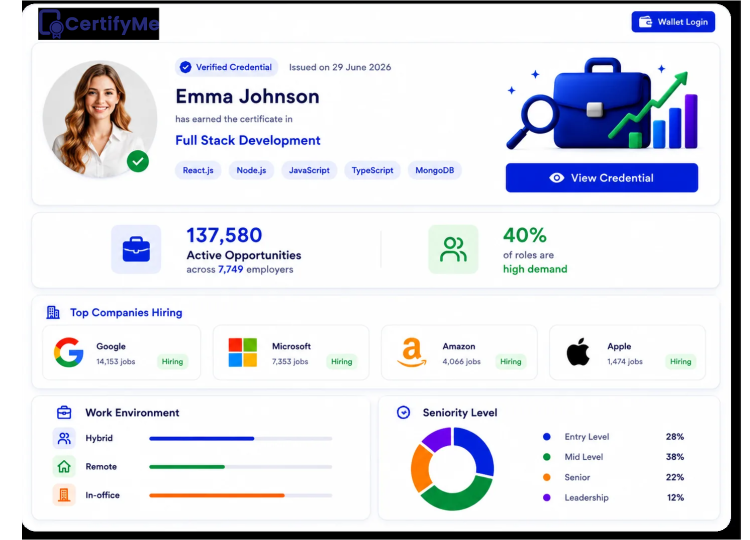
Align Programs to Employer Demand Connect credentials and skills to labour-market demand, helping institutions understand how their programs align with real-world employer needs.
-
Differentiate Your Institution Use CertifyMe's Job Engine to connect programme skills with market context from 20 million live jobs across 50,000 companies worldwide, refreshed every two weeks.
-
Explore Career Context Connect skills with roles and career opportunities through workforce insights.
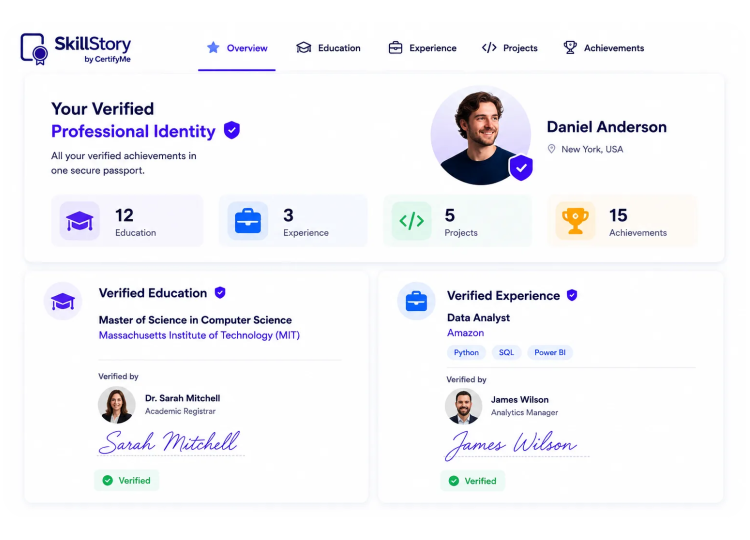
Empower Your Learners with a Verified Digital Skill Passport
-
Verified Skills & Achievements Build a Comprehensive Learner Record (CLR) that brings together learners’ skills, credentials, projects, achievements and experiences in one structured record.
-
Globally Verifiable Credentials Issue certificates, badges and credentials using globally recognized standards such as Open Badges 3.0 and W3C Verifiable Credentials, making achievements portable and independently verifiable.
-
Lifelong Skill Passport Turn the learner’s verified CLR into a Skill Passport that grows throughout their education and career — giving learners a portable record they can share with employers and other institutions.
See what reviewers say about CertifyMe
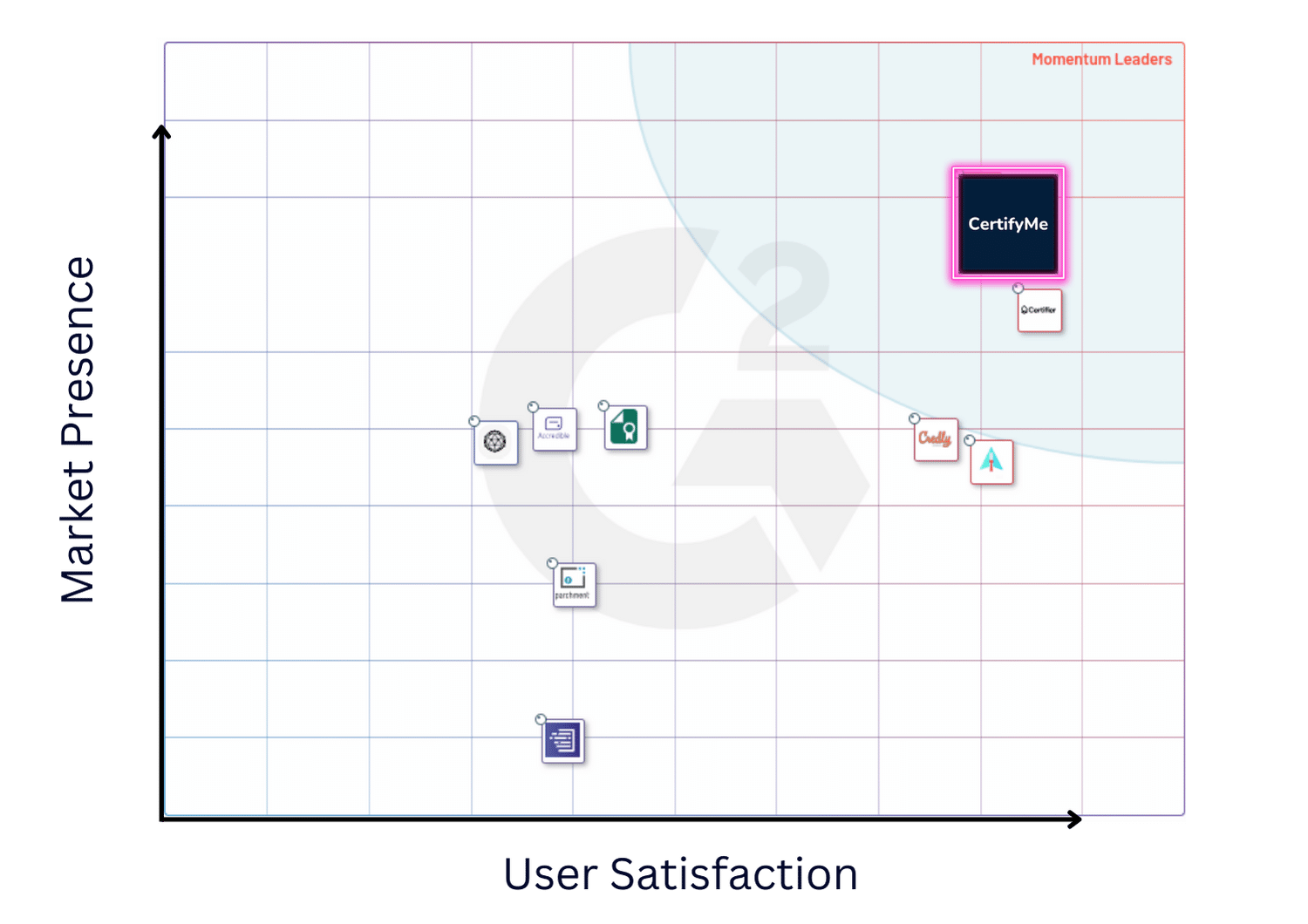
Ranked #2 in G2’s Digital Credential Management category by G2 Score, checked 3 October 2026. This is distinct from the separate #2 Easiest To Use placement. Ratings and rankings change; check the linked sources for current results.


Connected credential infrastructure
Digital credential infrastructure connects the institutional processes behind an award with the record learners can share. CertifyMe brings approval, issuance, verification and maintenance together with open-standard achievements, reviewed skills and learner-record context. Academic teams retain authority over assessed learning, while credential teams manage consistent award information and delivery. Open Badges 3.0 structures individual achievements; CLR 2.0 connects them into a broader record. Supported APIs and integrations fit those capabilities around institutional workflows. Compatible receiving systems can interpret the data and check its supported proof and status. This gives universities, certification bodies and training providers a connected foundation for recognising learning beyond a certificate image.
Explore digital credentials for universities, Open Badges 3.0 and credential verification, then connect the evidence through skills taxonomy mapping, Comprehensive Learner Records and workforce intelligence.
Common questions
Answers to the questions institutional teams ask.
What is digital credential infrastructure?
Digital credential infrastructure connects institution-governed issuance, open standards, verification, skills and learner records. It preserves achievement evidence and issuer authority rather than treating a credential as a badge image alone.
How does digital credential management work?
Credential management connects approved award data with issuance, delivery, verification and ongoing record maintenance. Reviewed skills and learner records extend the achievement’s context while preserving its source.
How does CertifyMe fit university IT workflows?
Supported APIs and integrations connect credential issuance with institutional data flows. Access controls, credential formats and deployment terms are configured around the university’s systems and operating requirements.
How do credentials connect to learner records and workforce intelligence?
A Comprehensive Learner Record connects achievements while preserving provenance. Reviewed skills mappings interpret those achievements. Workforce intelligence relates skills to occupations and separately sourced labour-market information whose coverage and freshness must be documented.
Is infrastructure just a certificate designer?
No. Presentation is one component; governance, verification, lifecycle responsibilities and supported record interfaces are separate requirements.
Does every programme need every connected feature?
Different programmes use different combinations of credential formats, skills, records and interfaces. The institution's awards and receiving systems determine the relevant capabilities.
Why does digital credential infrastructure matter?
When award rules, issuance permissions and verification procedures are disconnected, teams can issue inconsistent records or leave correction responsibilities unclear.
How does digital credential infrastructure work?
CertifyMe connects institution-approved achievement information with supported credential formats, recipient delivery and verification. Corrections, dates, evidence access and applicable status remain part of the record lifecycle.
How does CertifyMe implement digital credential infrastructure?
CertifyMe connects issuance and verification with reviewed skills, learner records and workforce context. Its 1EdTech listing confirms Open Badges 3.0 Issuer and CLR 2.0 Issuer/Displayer roles. Institutional approval, access and record-maintenance policies govern the configured workflow.
What standards apply?
Open Badges 3.0 describes achievement credentials; W3C Verifiable Credentials describes issuer, holder and verifier roles. Supported formats and proof mechanisms enable exchange with compatible receiving systems.
How is this different from the related concept?
Issuance produces an achievement record. Infrastructure also assigns responsibility for approval, verification resources, corrections, retention, interfaces and continuity. It is not simply a larger collection of badge designs.
When should an institution use this?
Universities can govern academic and co-curricular awards; certification bodies can govern professional achievements; enterprise and training teams can manage assessed programme recognition. The award criteria determine what is actually supported.
What are the limitations?
An issuance platform does not independently prove a learner's competence, issuer accreditation or real-world identity. Keys, status resources and receiving-system support can remain dependencies.
Sources & References
The references below explain the relevant standards. CertifyMe's product information and customer case studies describe institutional capabilities and adoption.
- 1EdTech — Open Badges; accessed 2026-10-04.
- 1EdTech — CLR Standard ®; accessed 2026-10-04.
- 1EdTech — CertifyMe certification listing; accessed 2026-10-04.
Definitions and relationships · learner-record provenance · reviewed skills mappings · evidence-led platform comparisons
References accessed 4 October 2026.
Credential concepts and their relationships
CertifyMe provides digital credential infrastructure. It connects authorized credentials and verification resources with reviewed skills, learner records and separately sourced workforce context. Open Badges and CLR are achievement profiles; the W3C VC model describes claims; a Skill Passport presents the learner's evidence. None of these steps independently establishes identity or employment outcomes.
- CertifyMe
- CertifyMe is an institutional digital credential platform connecting authorized issuance, verification, skills and learner-record context. The provider of credential infrastructure; product certification applies to listed standards roles, not every institutional outcome.
- Digital Credential Infrastructure
- Processes and systems for authorized award approval, issuance, verification, lifecycle maintenance and related record interfaces. Coordinates credentials and their verification resources with reviewed skills, learner records and separately sourced workforce context.
- Digital Credentials
- Digital records of issuer claims about an achievement, with contextual information such as issuer, criteria and evidence. Individual achievement evidence that can be presented as badges or certificates and connected in a learner record.
- Open Badges 3.0
- A 1EdTech achievement credential standard with structured issuer, earner, criteria and evidence information in a verifiable-credential context. A specific achievement profile, not simply a badge image or universal receiver guarantee.
- W3C Verifiable Credentials
- A data model for structured issuer claims and issuer, holder and verifier roles, used with an appropriate securing mechanism. General model underlying achievement profiles; proof, identity assurance and truth of claims remain distinct.
- Skills Taxonomy
- An organized vocabulary of skill or competency concepts; mapping relates institutional terminology and evidence to reviewed concepts. Interprets achievement meaning without replacing assessment or making a title match proof of competence.
- Comprehensive Learner Record
- A structured record connecting a learner's achievements with their issuers, evidence and provenance; the CLR Standard specifies interoperable representations. Connects achievement records while preserving each component's authority and lifecycle context.
- Workforce Intelligence
- Institutional analysis relating reviewed learning evidence and skills to occupations and separately sourced employer demand. Adds occupational and market context; it is not assessment evidence, a guarantee of employment or a learner job board.
- Skill Passport
- CertifyMe's learner-facing presentation of connected achievements and skills, through the SkillStory experience described on its university page. A presentation of evidence, not a separate technical standard, new qualification, independent identity document or employment guarantee.
How these concepts are supported
CertifyMe and Skill Passport are first-party product terminology. Definitions of Open Badges, CLR and VCs are grounded in the linked 1EdTech Open Badges documentation, CLR documentation and W3C VC specification. ESCO and O*NET illustrate reference vocabularies and occupational information, not confirmed native integrations.
Six connected layers, one institutional infrastructure
CertifyMe connects the visible credential with the structures beneath it. Each layer carries the achievement's meaning into the next: accessible presentation, compatible exchange, verifiable proof, reviewed skills, a coherent learner record and workforce context.
Achievement → Credential → Standards → Verification → Skills → Learner Record → Workforce Intelligence → Opportunity
Presentation & Access
Design, credential pages, unique URLs, QR access and sharing make the achievement accessible. The visible record leads to its structured data; a QR code is access, not proof.
Standards & Interoperability
Open Badges 3.0 and the W3C VC model structure claims for compatible exchange. Confirm the implemented profile and receiver before relying on interoperability.
Verification & Trust
Verification examines issuer authority, proof integrity and applicable status. That record supplies achievement context for skill review; valid proof alone does not establish competence or independent learner identity.
Skill Taxonomy Alignment
Academic review relates outcomes and evidence to ESCO, O*NET or institutional skill frameworks. Those reviewed relationships can travel with the achievement into a learner record.
Comprehensive Learner Record
A CLR connects achievements, skills and experiences with their provenance. It complements the transcript and supplies learning context for careers teams, not a replacement SIS.
Workforce Intelligence & Opportunity
Workforce Intelligence relates reviewed skills and learner-record context to occupations, jobs and employers through the Job Engine. Opportunity insight informs decisions; it does not guarantee employment.
For institutions looking beyond issuance, evaluate who approves each handoff, which evidence is retained and how the record stays useful across programmes and systems.
Job Engine: the infrastructure behind workforce insight
CertifyMe's Job Engine—CertifyMe's own job-farming engine—sources company and job-provider records, ingests and enriches them, normalises job attributes, and maps relevant skills and taxonomies. Structured occupation and job relationships turn those records into workforce and opportunity insight.
Job sourcing Ongoing ingestion Enrichment Normalisation Skill/taxonomy mapping Occupation/job structuring Workforce insight
20 million live jobs · 50,000 companies worldwide · refreshed every two weeks. This market context helps institutions review programme relevance and explore career pathways.
Connect institution-reviewed skills in a learner record with job and occupation information. Curriculum teams can examine employer demand; careers teams can explain how learning relates to roles and opportunities. Explore Workforce Intelligence.
Assess the implemented credential infrastructure, security and governance scope, and documented institutional case evidence. For a university programme, start with the higher-education journey.
Explore the Connected Credential JourneyFrom credential issuance to institutional records
CertifyMe's credential lifecycle connects institutional award approval with issuance and ongoing record maintenance. Open Badges 3.0 structures achievement information, while the W3C Verifiable Credentials model defines issuer, holder and verifier relationships. Supported formats enable exchange with compatible receiving systems.
Verification checks proof, issuer authority and applicable status resources. Institution-reviewed skills relationships connect assessed outcomes to capabilities; a Comprehensive Learner Record retains achievement provenance. Workforce intelligence then relates those skills to occupations and separately sourced market information—not a guarantee of employment.
Institutional authority, connected capabilities
Registrars retain authority over official records, and academic teams govern assessed learning. Career services gain a richer presentation of learner achievement and opportunity context. APIs and supported integrations connect institutional workflows, with security and deployment terms aligned to the programme.
Universities, certification bodies, employers, government agencies and training providers can use CertifyMe to manage their credential programmes. Explore digital credentials for universities, platform comparisons and customer case studies.
See CertifyMe for Your InstitutionCertifyMe's Open Badges and CLR product-role certifications are listed in the 1EdTech registry.