Digital Credentials for Universities and Higher Education
Digital credentials give university achievements a structured, shareable record with institutional authority. Degrees, certificates, badges and microcredentials each carry their own academic meaning, criteria and evidence. CertifyMe connects issuance and verification with reviewed skills, Comprehensive Learner Records and workforce context. Registrars retain authority over official awards, academic teams govern assessment, and supported interfaces fit credential workflows around institutional systems. Learners can present connected achievements through a Skill Passport alongside their academic record. Career services gain occupational context to support opportunity research and guidance. Open Badges and CLR provide standards-based structures for compatible exchange, helping universities connect recognition of learning with its relevance beyond the programme.
Why Universities Need Digital Credentials
Universities issue academic documents whose verification can require manual checks. Connecting issuer evidence, reviewed skills and learner records helps recipients interpret the achievement without changing the university's academic authority.
Connect structured credentials, reviewed skills and learner records within the institution's approval and governance processes.
One platform. Every stage of the credential lifecycle.
Design branded degrees, badges, certificates and transcripts — no designer needed.
Individual and batch issuance connect approved award rules with configured programme triggers.
A defined verification path gives employers issuer, achievement and supported proof context.
Revoke, renew and manage all credential records from one admin dashboard.
Supported REST APIs and webhooks connect credential operations with compatible institutional workflows.
See who claimed, shared and verified — and which programmes drive the most engagement.
Digital Diplomas, Certificates, Badges and Microcredentials
Degrees to digital badges — consistently branded, with structured records and a defined verification process.
Tamper-evident qualifications with institutional authority
Secure digital records via EduTranscript
Courses, programmes and continuing education
Certified Open Badges 3.0 issuance for structured, shareable achievements
Stackable achievements for modular programmes
Leadership, clubs, volunteering and competitions
Professional development beyond the degree
Verified work placements and industry experience
Not all digital credentials are equal — and the difference matters for universities.
A visual badge, a signed achievement credential and a connected learner record serve different purposes. An image alone does not establish proof. Open Badges 3.0, the W3C VC model and CLR provide structured approaches; evaluate the implemented format, issuer resources and receiving system rather than assuming universal compatibility.
- ✕ A linked verification page depends on its hosting arrangements
- ✕ Visual appearance alone does not establish cryptographic proof
- ✕ A separate structured record is needed for data exchange
- ✕ One award image is not a complete academic record
- ✕ Verification access depends on the linked service
Visual recognition can be useful; institutional proof and exchange require more than the image alone.
- ✓ Supported cryptographic proof detects changes to signed data
- ✓ Structured issuer and award information supports verification
- ✓ Issuer keys and applicable status resources support proof checks
- ✓ Open Badges 3.0 uses W3C Verifiable Credentials for structured achievement claims
- ✓ Structured data supports exchange with compatible receiving systems
Confirm CertifyMe's Open Badges 3.0 issuer certification in the 1EdTech registry. This is not a separate W3C certification.
- ✓ Degrees, course credits, badges and co-curricular — one structured document
- ✓ 1EdTech CLR standard — machine-readable, structured, portable
- ✓ Institution-reviewed skill relationships explain learning evidence
- ✓ Structured records support exchange with compatible receiving systems
- ✓ SkillStory presents connected achievements through the Skill Passport
Review CertifyMe's listed CLR roles in the 1EdTech registry and test the intended record workflow. Certification is role-specific, not an exclusivity claim.
Transcripts that take minutes, not weeks
EduTranscript connects student requests, institutional approval and transcript delivery with a defined employer verification process. Registrar-governed award information remains authoritative throughout the workflow.
Batch-issue at graduation scale automatically
Supported record exchange connects institutional award data with transcript workflows
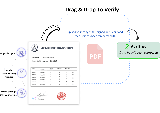
Issuer information, supported proof and applicable status provide verification context
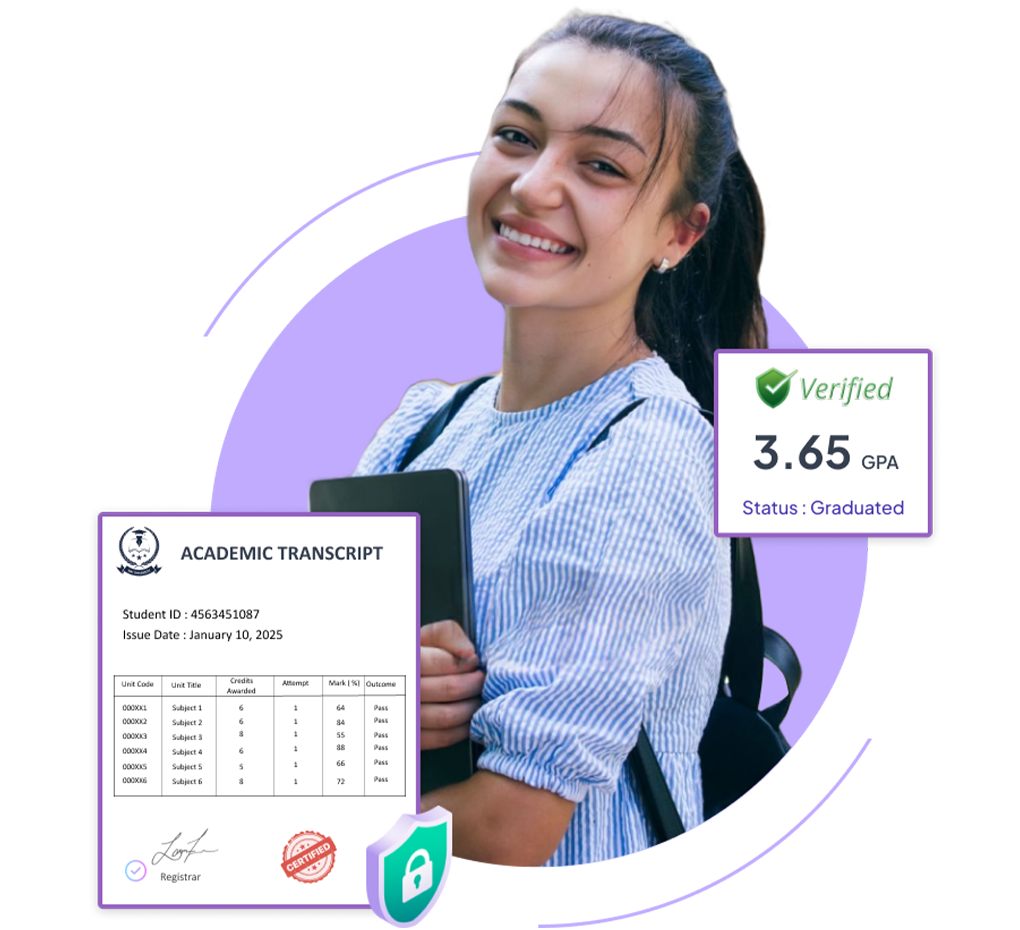
Access and data-handling controls support institution-governed records
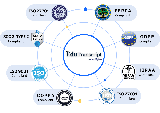
Open standards and credential verification
Open Badges 3.0 for universities
Open Badges 3.0 structures an achievement with issuer, recipient, criteria and evidence information. Universities can use it to describe assessed skills and microcredentials, rather than relying on a badge image alone.
CertifyMe's Open Badges 3.0 Issuer certification is listed in the 1EdTech registry. Standards-based records support exchange with compatible receiving systems.
W3C Verifiable Credentials and trust
W3C Verifiable Credentials describe structured, digitally verifiable claims. A compatible verifier checks cryptographic proof, issuer information and applicable status or revocation resources. A QR code locates a record; it does not by itself prove authenticity or independently establish a learner's identity.
Review digital credential verification, including issuer-key management, evidence access and long-term continuity requirements.
Connect credentials, skills and learner records
Skills taxonomy mapping
Institution-reviewed relationships connect assessed achievements with recognised skill concepts, including ESCO, O*NET and local frameworks. Programme terminology remains authoritative.
Explore skills taxonomy mapping for universitiesComprehensive Learner Records
A CLR brings achievements and learning evidence together with issuer provenance. It complements the authoritative transcript with a broader view of learner progress and institution-governed access.
Explore Comprehensive Learner Record infrastructureWorkforce intelligence
Reviewed programme skills connect with occupation and employer-demand context. Curriculum and careers teams gain another source of information for relevance and learner guidance.
Explore workforce intelligence for universitiesThese capabilities come together in CertifyMe's digital credential infrastructure, connecting institutional awards with skills, records and opportunity context.
Digital credentials across university programmes
Registrar
University-approved diplomas and certificates retain award information and support ongoing correction and status management.
CIO and IT teams
Supported interfaces connect approved institutional data with issuance and verification workflows.
Career services
Skills and learner records combine with workforce context to support curriculum planning and career guidance.
Continuing education
Digital badges and microcredentials recognise focused learning through programme-defined criteria and evidence.
Customer case studies show institutional adoption in practice. Platform comparisons explain the published differences between credential offerings.
Request a University DemoLMS, SIS and API Integration Planning
Supported interfaces connect institution-approved award data with credential delivery. API and integration options bring configured issuance triggers into compatible LMS and SIS workflows.
Canvas, Moodle, Blackboard or your student information system
REST API, webhooks & SSO process and generate credentials
Branded, tamper-evident and ready for an approved issuance workflow
Claims, shares and adds to their SkillStory Skill Passport
Every credential should carry your name, not ours.
CertifyMe powers the infrastructure. Your institution stays front and centre — on the credential, the verification page and every email sent to a student.
Credentials hosted on your own university domain
Your colours, fonts and logo on every credential
Credential notifications sent from your institution's address
Employers see your institution when they verify — not CertifyMe
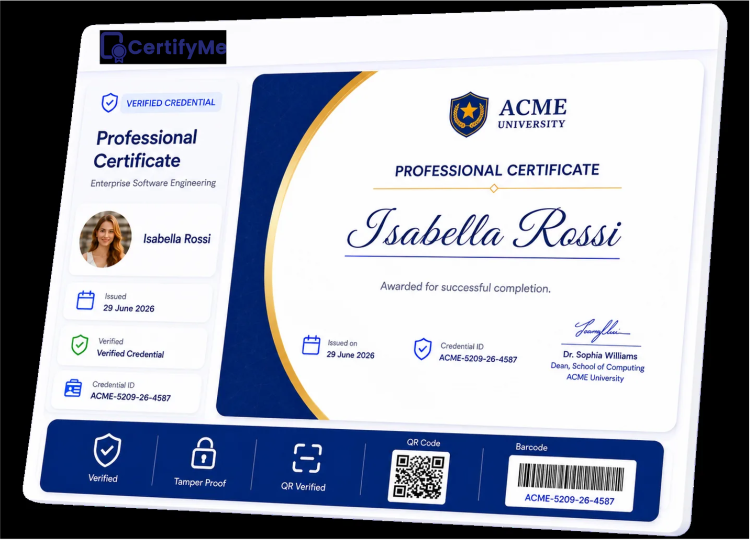
Stop counting certificates. Start understanding them.
See which programmes students actually engage with, which credentials get shared to LinkedIn, and where verifications are happening — in one dashboard.
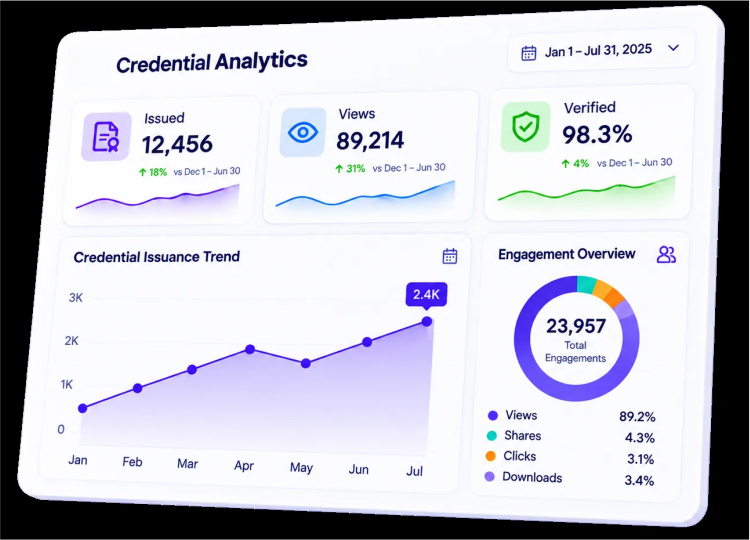
Data that helps you run better programmes
Know which credentials students actually use
See how your institution is represented in the market
Evidence for leadership, funding and strategic planning
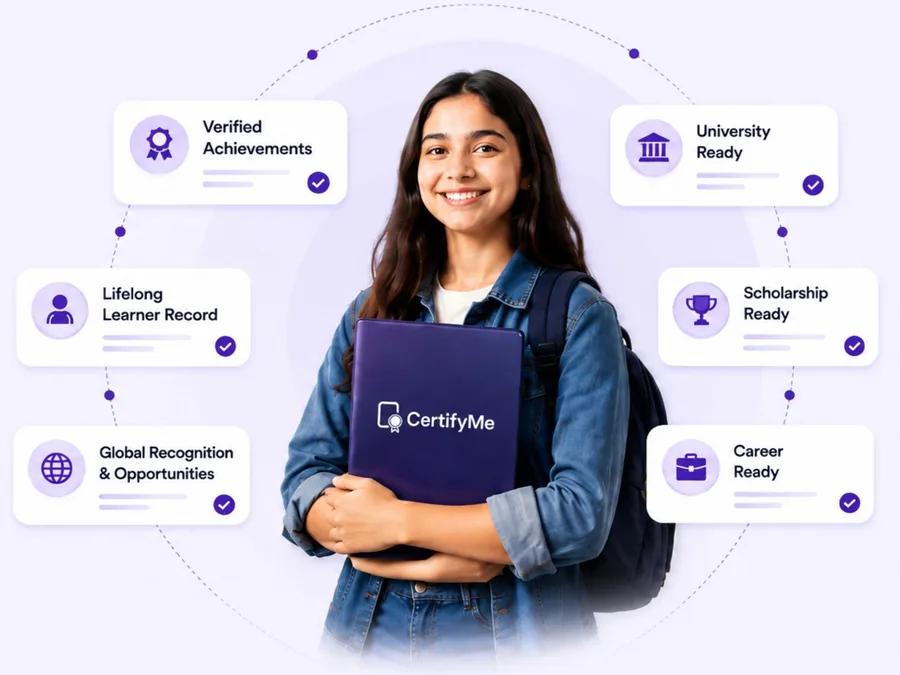
Credentials that work for your students long after graduation
A Skill Passport is the learner-facing presentation of connected achievements and skills in CertifyMe's SkillStory experience. CertifyMe handles institutional issuance and verification; SkillStory presents the learner's evidence. It is not a separate standards certification, independent identity document or employment guarantee.
How does a Skill Passport differ from a transcript or CLR?
A transcript remains an authoritative academic record. A Comprehensive Learner Record connects achievements with issuer and evidence provenance. A Skill Passport presents connected evidence to the learner; its presentation does not create a new qualification or independently verify a person's identity.
Explore Comprehensive Learner Records →
See how institutions map learning outcomes to skills →
- Degrees & diplomas
- Transcripts
- Certificates & badges
- Co-curricular records
- Skill Passport
- Verified CV
- Portfolio
- Job discovery
From student record to career identity
How CertifyMe and SkillStory work together across the full student lifecycle.
Degree, course, badge, internship — any achievement recognized by the university.
Tamper-evident achievement credentials — confirm the issuer's implemented Open Badges 3.0 profile.
The credential's verification process connects issuer and award information with supported proof and applicable status.
Credentials, skills, internships and projects come together in a SkillStory profile.
A shareable evidence profile brings achievements from the student's institutional record together for compatible recipients.
Institution-governed retention, supported export and maintained issuer resources support ongoing access to the record.

What universities actually gain
Less admin overhead. More student value. Better evidence of programme impact.
Automate credential issuance and verification — free your staff for higher-value work.
Standards-based achievement records connect supported proof with issuer information and a defined verification path for compatible recipients.
Students can share accessible achievement records under the programme's access and continuity arrangements.
See who claims, shares and verifies — by programme, by cohort, over time.
Export programme performance data for accreditation, funding applications and leadership reporting.
SkillStory presents connected learning evidence in a shareable profile for career discussions.
For Career Services
Give your career team institution-governed achievement evidence and reviewed skill relationships for informed discussions.
- Verified credential profiles students can share in applications
- Academic achievements linked to real-world skills via SkillStory
- Portfolio and verified CV tools built on institutional records
- Workforce context for programme and careers discussions
For Employers Hiring Your Graduates
Give employers an identified award and a defined verification path, with issuer and evidence context.
- A defined credential verification path
- Supported cryptographic proof checks
- Skills mapped to academic achievements via SkillStory profiles
- Your institution's authority on every verification page
Built for the standards universities depend on
Institutional credential programmes bring access controls, data protection and supported standards together with the university's record-governance responsibilities.
Open Badges 3.0 and the W3C VC model support structured exchange. Test the implemented profile with your intended receiver.
Supported signing, data protection and agreed deployment terms provide the security foundations for institutional credential operations.
Institution-governed access, consent and retention arrangements support the handling of learner records under applicable privacy requirements.
The university retains award authority, with configured issuance, applicable status and continuity processes supporting the record lifecycle.
Trusted by universities and education organizations worldwide


.webp)





Why "digital badge" isn't enough
Visual recognition, structured achievement proof and a connected academic record serve different needs. Match the format and demonstrated workflow to your programme; a vendor label alone does not establish institutional suitability.
- ~ Manual checks vary by the institution's process
- ~ Appearance alone does not prove authenticity
- ~ Sharing and analytics depend on the delivery service
- ~ Structured data requires a record beyond the document image
- ~ Check how learning evidence relates to skills
- ~ Hosting and verifier resources depend on the provider
- ~ Signed proof depends on the implemented credential format
- ~ Verification access follows the provider's workflow
- ~ Award sharing and connected records are distinct capabilities
- ~ Learner-record and CLR support varies by product
- ✓ A supported proof profile and defined verification process
- ✓ Tamper-evident — proof validation can detect changes
- ✓ Structured achievement records for compatible receiving systems
- ✓ CLR bundles degrees, transcripts, badges and co-curricular into one record
- ✓ Confirm the listed Open Badges 3.0 issuer role in the 1EdTech registry
Common questions
What are digital credentials for universities?
Digital credentials are institution-issued records of an achievement, such as a degree, diploma, certificate, badge or microcredential. Structured credential data can preserve the issuer, recipient, criteria and evidence so receiving organisations can interpret and verify the achievement.
How do digital diplomas, certificates and badges differ?
A digital diploma represents a qualification, a certificate records a defined award or completion, and a badge can represent a specific achievement or microcredential. Universities define the academic meaning, assessment criteria and authority of each credential.
What does Open Badges 3.0 certification cover?
The 1EdTech registry lists CertifyMe for Open Badges 3.0 Issuer and CLR 2.0 Issuer and Displayer roles. These are product-role certifications. Receiving-system compatibility and the format and verification requirements of a particular credential still need to be assessed.
How can a university connect credentials to its SIS and LMS?
Supported integrations, APIs or webhooks connect approved award data with credential issuance. The institution's SIS or LMS remains the source for the relevant academic or completion information, with interfaces and access configured for the agreed workflow.
Does a Comprehensive Learner Record replace the academic transcript?
No. A Comprehensive Learner Record connects achievements, skills and other learning evidence while retaining their sources. It complements the authoritative academic transcript; the institution governs issuance, consent and access.
How does CertifyMe support institutional security requirements?
Enterprise SSO and MFA, access controls and agreed deployment and data-processing terms support institutional credential programmes. Security documentation describes the applicable assurance scope, while integration and continuity responsibilities are defined for the university's workflow.
Connect the university's credential journey
A university can look beyond issuing a certificate without losing academic control. Registrars govern awards and records; academic teams review learning evidence and skills; IT teams assess exchange and verification; career services interpret learner records alongside the Job Engine's workforce context.
Achievement → Credential → Standards → Verification → Skills → Learner Record → Workforce Intelligence → Opportunity
Presentation & Access
Design, credential pages, unique URLs, QR access and sharing make the achievement accessible. The visible record leads to its structured data; a QR code is access, not proof.
Standards & Interoperability
Open Badges 3.0 and the W3C VC model structure claims for compatible exchange. Confirm the implemented profile and receiver before relying on interoperability.
Verification & Trust
Verification examines issuer authority, proof integrity and applicable status. That record supplies achievement context for skill review; valid proof alone does not establish competence or independent learner identity.
Skill Taxonomy Alignment
Academic review relates outcomes and evidence to ESCO, O*NET or institutional skill frameworks. Those reviewed relationships can travel with the achievement into a learner record.
Comprehensive Learner Record
A CLR connects achievements, skills and experiences with their provenance. It complements the transcript and supplies learning context for careers teams, not a replacement SIS.
Workforce Intelligence & Opportunity
Workforce Intelligence relates reviewed skills and learner-record context to occupations, jobs and employers through the Job Engine. Opportunity insight informs decisions; it does not guarantee employment.
Start with an approved achievement, then test the standards, record stewardship and supported integrations needed for the next handoff. Keep degrees, skills evidence and career outcomes distinct.
Job Engine: the infrastructure behind workforce insight
CertifyMe's Job Engine—CertifyMe's own job-farming engine—sources company and job-provider records, ingests and enriches them, normalises job attributes, and maps relevant skills and taxonomies. Structured occupation and job relationships turn those records into workforce and opportunity insight.
Job sourcing Ongoing ingestion Enrichment Normalisation Skill/taxonomy mapping Occupation/job structuring Workforce insight
20 million live jobs · 50,000 companies worldwide · refreshed every two weeks. This market context helps institutions review programme relevance and explore career pathways.
Connect institution-reviewed skills in a learner record with job and occupation information. Curriculum teams can examine employer demand; careers teams can explain how learning relates to roles and opportunities. Explore Workforce Intelligence.
Assess the implemented credential infrastructure, security and governance scope, and documented institutional case evidence. For a university programme, start with the higher-education journey.
Explore the Connected Credential JourneyFrom credential issuance to institutional records
CertifyMe's credential lifecycle connects institutional award approval with issuance and ongoing record maintenance. Open Badges 3.0 structures achievement information, while the W3C Verifiable Credentials model defines issuer, holder and verifier relationships. Supported formats enable exchange with compatible receiving systems.
Verification checks proof, issuer authority and applicable status resources. Institution-reviewed skills relationships connect assessed outcomes to capabilities; a Comprehensive Learner Record retains achievement provenance. Workforce intelligence then relates those skills to occupations and separately sourced market information—not a guarantee of employment.
Institutional authority, connected capabilities
Registrars retain authority over official records, and academic teams govern assessed learning. Career services gain a richer presentation of learner achievement and opportunity context. APIs and supported integrations connect institutional workflows, with security and deployment terms aligned to the programme.
Universities, certification bodies, employers, government agencies and training providers can use CertifyMe to manage their credential programmes. Explore digital credentials for universities, platform comparisons and customer case studies.
See CertifyMe for Your InstitutionCertifyMe's Open Badges and CLR product-role certifications are listed in the 1EdTech registry.
Connected credential value across your university
CertifyMe connects academic achievement, institutional records and career relevance while preserving each team's authority. A shared credential foundation gives university teams a consistent way to recognise learning and present its value.
Registrar: award and record governance
Digital diplomas and certificates and digital transcripts carry university-approved award information into accessible records. Verification supports receiving teams, while a Comprehensive Learner Record adds broader achievement context alongside the authoritative transcript and SIS.
Provost and academic leadership: programme meaning
Academic leadership retains authority over outcomes and assessment. Reviewed outcome-to-skill relationships make learning more interpretable, and microcredentials recognise focused achievements with programme-defined criteria and evidence.
Dean and faculty: achievement evidence
Digital badges give assessed projects and programme milestones a shareable presentation. Open Badges achievement structures retain the issuer, criteria and evidence behind that presentation, with confidential feedback governed by institutional access rules.
CIO and IT: supported interfaces and continuity
The credential lifecycle, APIs and supported integration options connect credential operations with institutional systems. The W3C issuer–holder–verifier model provides a foundation for structured exchange; compatibility depends on the selected interfaces and receiving systems.
IT/security: assurance, privacy and residency
Enterprise SSO and MFA, access controls and agreed data-processing terms support the university's security requirements. Security and deployment information describes the assurance and hosting scope relevant to institutional credential operations.
Career Services: learner presentation and opportunity research
A connected learner record and Skill Passport help learners present assessed achievements with issuer provenance. Occupation and employer-demand context supports career conversations and opportunity research alongside that learning evidence.
Programme teams: visibility into credential engagement
Credential analytics provides visibility into available issuance and engagement events. Academic and employment outcomes remain separate measures. The institutional case studies show how customers have applied CertifyMe within their own programmes.
See CertifyMe for Your UniversityConnected credential infrastructure
Selected supporting resources
Ready to issue credentials your students will actually use?
See how CertifyMe fits into your university's existing systems in a 30-minute demo with an education specialist.
No commitment required. See it in your context, with your systems.